

Reverse Osmosis Maintenance: What It Takes to Keep Pure Water Flowing
You bought a reverse osmosis system because you wanted water that was actually clean. The good news: with the right care, that reverse osmosis system will deliver 95 to 99 percent contaminant rejection for fifteen to twenty years. The not-so-good news: it won't do that on its own. Pre-filters clog. Membranes foul. Storage tanks grow biofilm if nobody opens them.
This guide covers what residential reverse osmosis maintenance actually looks like, both point-of-use (POU) under-sink units and whole house RO setups. The core principles overlap, but the procedures, frequencies, and components differ in ways that matter. The schedule below reflects what Crystal Quest's specialists have learned actually keeps an RO system running for two decades, not what looks tidy on a spec sheet.
Why Reverse Osmosis Maintenance Matters
Here is what your RO system is actually doing on a normal day: pushing water through a semipermeable membrane that strips out up to 99 percent of dissolved contaminants, including lead, arsenic, fluoride, nitrates, and PFAS (all of which the EPA regulates under the National Primary Drinking Water Regulations). The catch is that none of that happens automatically. Pre-filters clog and starve the membrane of the protection it needs. The membrane itself fouls and starts letting contaminants slip through. Storage tanks, sitting in the dark with stagnant water between uses, develop biofilm that puts bacteria right back into otherwise clean water.
Regular RO maintenance is what stops that quiet failure from happening. Stay on the schedule and you protect water quality, you skip the emergency repairs that come from a starved membrane, and you roughly double how long the system lasts. Ten years becomes twenty-plus.
Pick the Right Guide for Your RO System
This article is the comprehensive overview. If you want a focused walkthrough for your specific setup, three companion guides go deeper on the system type you actually own.
- Quick Start Guide: for first-time RO owners who want the essentials in 5 minutes. Covers monthly checks, when to call for help, and the basic schedule.
- Point-of-Use RO Guide: for owners of under-sink and countertop RO units with pressurized storage tanks. Covers POU-specific procedures, tank pressure, and drinking-water faucet care.
- Whole House RO Guide: for owners with multiple membranes and atmospheric storage. Covers multi-membrane systems, atmospheric tanks, UV integration, and scaled flush procedures.
Your Complete Reverse Osmosis Maintenance Schedule
RO maintenance follows a predictable rhythm. Some tasks differ between POU and whole house systems (those differences are called out below). Use this as your master schedule, then drop into the procedure sections for the actual steps.
| Maintenance Task | What You Do | Frequency | Time |
|---|---|---|---|
| Visual and pressure check | Look for leaks, test flow, read pressure gauge | Monthly | 5 min |
| TDS test | Compare tap and RO water with a TDS meter | Monthly | 5 min |
| Pre-filter replacement | Sediment, SMART, and carbon block pre-filters | 12-24 months (avg 18) | 30 min |
| Post-filter replacement (whole house RO) | Polish and optional remineralizer cartridges | 12-24 months (avg 18) | 20 min |
| Inline post-filter (POU RO) | Polishing cartridge swaps with the membrane | 2-4 years (with membrane) | 10 min |
| System sanitization | Clean housings, tank, and tubing | 12 months | 1-2 hrs |
| Storage tank cleaning (POU only) | Sanitize and flush pressurized tank | 12-24 months | 1 hr |
| RO membrane replacement | POU: 1 membrane. Whole house: 2-6 membranes. | 2-4 years (avg 3) | 45 min POU / 2-3 hrs WH |
| Professional inspection | Full system check by a technician | 2-3 years | 1 hr |
Understanding Your RO System Components
A residential RO system runs water through a series of stages, and each one does a specific job. The maintenance signals are different at every stage, so knowing what each piece is supposed to do is a big part of catching problems before they become real ones.

Pre-Filtration Stages
Pre-filters do the protective work before water ever reaches the RO membrane. They trap particles, neutralize chlorine and chloramines (which would destroy the membrane on contact), and capture organic chemicals. The exact pre-filter combination depends on which Crystal Quest system you own:
- Under-sink RO (Thunder series): ultrafiltration, SMART multimedia, and carbon block.
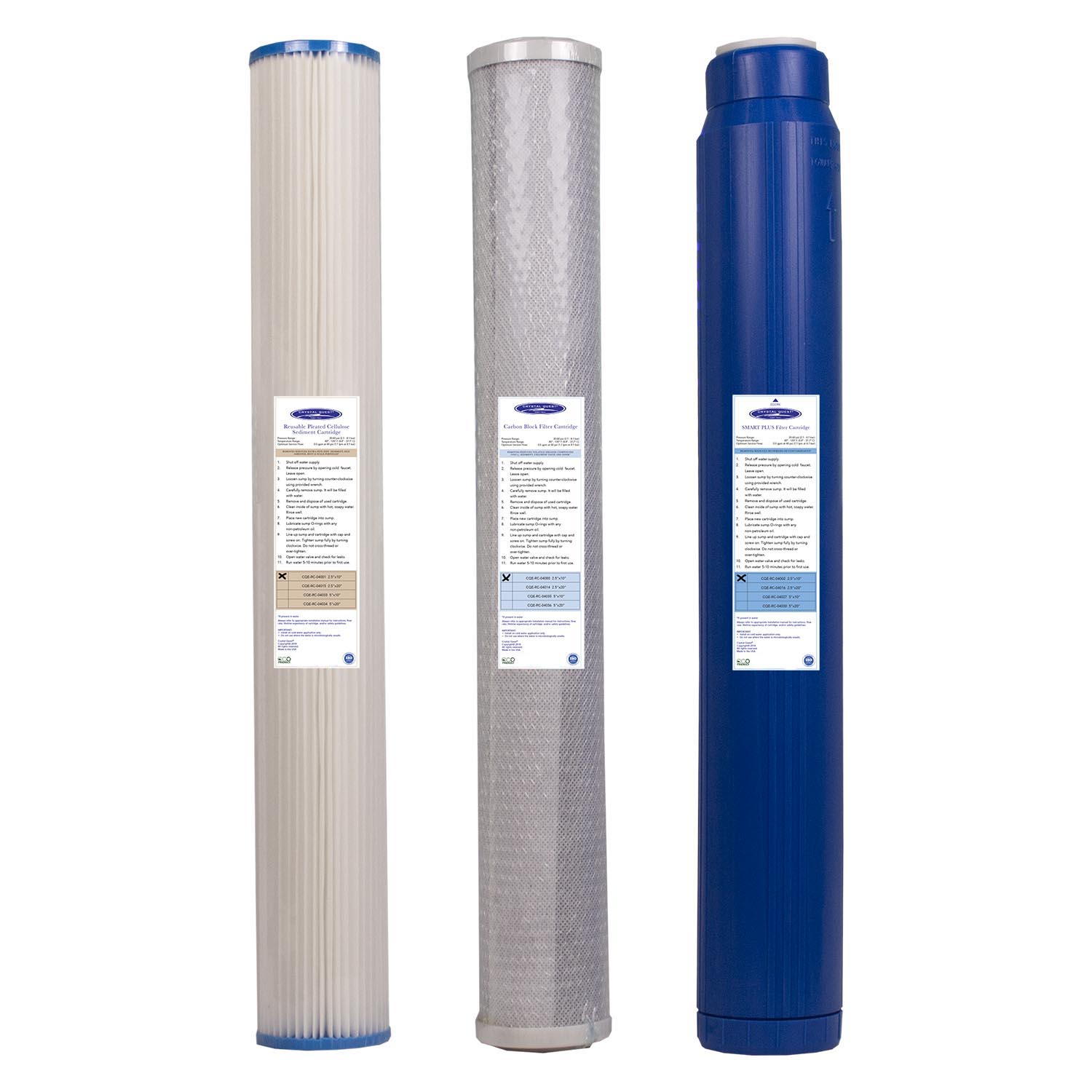
- Whole house RO: pleated sediment, SMART carbon, and carbon block.
- Smaller two-stage units: sediment and SMART.
SMART is Crystal Quest's proprietary multimedia cartridge, designed to handle a broader contaminant range than single-media filters can on their own. Replacement filter packs are matched to your specific system, so the right combination ships together when it's time to swap them out.
- Function: Protect the RO membrane from sediment, chlorine, chloramines, and organic chemicals.
- Lifespan: 12 to 24 months (average 18).
- Failure signs: Reduced water pressure, chlorine taste coming through the RO faucet, or visible buildup when you open a housing.
RO Membrane: The Heart of the System
The semipermeable membrane is where the real purification happens. Pressure pushes water molecules through pores so tight that almost nothing else fits. Heavy metals, salts, bacteria, dissolved solids, and chemicals all stay behind and flush down the drain. The EPA identifies reverse osmosis as one of the recognized treatment options for reducing PFAS in residential drinking water, which gives you a sense of how thorough the rejection actually is. Crystal Quest stocks three membrane families for different feed water conditions: freshwater membranes for typical municipal supply, brackish water membranes for higher TDS, and desalination membranes for high-salinity sources.
- What it removes: Lead, arsenic, fluoride, nitrates, PFAS, bacteria, viruses.
- Lifespan: 2 to 4 years (average 3).
- Performance indicator: TDS rejection should stay above 90 percent. Peak performance hits 95 to 99 percent.
Post-Carbon Filter
The polishing stage. After the membrane, water passes through a final carbon filter that catches any residual taste or odor before it reaches the faucet.
- Function: Final taste and odor cleanup.
- Lifespan: 12 to 24 months (average 18).
- Failure signs: Flat or stale-tasting water.
Remineralizer (Optional)
RO water is, by design, almost completely demineralized, which leaves it slightly acidic (typical pH 5 to 6). A remineralizer cartridge adds calcium, magnesium, and trace minerals back, raising pH to roughly 7.5 to 8.5. Crystal Quest offers alkaline and remineralizer cartridges for under-sink and countertop systems, plus whole house alkalinity systems for homes that want consistent mineral content at every tap. Whole house owners often add remineralization specifically for pH stabilization, since mildly acidic water can corrode copper plumbing over time.
- Function: Restores beneficial minerals, raises pH, and protects copper plumbing on whole house systems.
- Lifespan: 12 to 24 months (average 18).
- Failure signs: Acidic taste, pH measurements below 7.0.
Monthly Checks: A 5-Minute Routine
Five minutes a month catches roughly 90 percent of issues before they turn into something expensive. The routine is the same for POU and whole house systems: a visual leak check, a pressure gauge reading (should sit between 45 and 60 PSI), a flow test at the faucet or downstream taps, a TDS meter comparison between tap and RO output (90 percent or greater rejection is normal), a taste test for any off flavors, and a quick listen for unusual sounds like constant running or short-cycling pumps. That's it. Set a calendar reminder and forget about it the rest of the month.
Keep a simple log with monthly TDS readings, dates, and observations. After six months you'll have a clear performance trend, and you'll know whether your filters are tracking the average or whether your specific water conditions push them faster.
For a beginner-friendly walkthrough of each check with placement-specific tips, see Crystal Quest's 5-Minute RO Maintenance Quick Start.
Filter Replacement: Every 12 to 24 Months
Pre-filters carry the load that protects the RO membrane. When they clog, the membrane takes the hit. Most systems average 18 months between pre-filter changes, though whole house systems sometimes need them sooner because they process every gallon coming into the home, not just drinking water. On whole house systems, post-filters are on the same 18-month cycle. POU inline post-filters are different: they swap with the membrane every 2 to 4 years, not on the pre-filter cycle.
When It's Time
- It's been 18 months since the last pre-filter replacement.
- Water flow has noticeably slowed.
- Filters look dark or visibly clogged.
- TDS readings are creeping up.
- The water has developed an off taste.
What the Job Looks Like
The procedure is straightforward: shut off the feed water and tank valve, depressurize the system through the faucet, unscrew the housings with a filter housing wrench, swap cartridges (watching for flow-direction arrows), inspect O-rings, reassemble hand-tight plus a quarter turn, and flush the new filters for 5 to 10 minutes before drinking. Most owners finish in under 30 minutes.
For the full step-by-step with system-specific quirks, O-ring inspection details, and troubleshooting for the most common reassembly mistakes, see Crystal Quest's complete RO filter replacement guide.
Annual Sanitization: Eliminating Biofilm
Sanitization is the maintenance task most homeowners skip, and it's the one that quietly causes the most problems. Bacteria and biofilm build up in housings, tubing, and especially in pressurized POU storage tanks where water sits between uses. Once a year clears it out before it has a chance to colonize the membrane or affect water quality.
Whole house systems with atmospheric tanks and a dedicated UV sterilizer downstream can sometimes go longer between sanitizations, but most systems benefit from the annual routine.
What the Job Looks Like
Sanitization works by circulating a dilute bleach solution through the empty housings to kill bacteria and biofilm before fresh filters go back in. The recipe is 2 tablespoons of unscented household bleach per 1 gallon of clean water, scaled up proportionally for whole house systems. Soak time is 30 to 60 minutes. Flushing is the part that matters most: POU systems need at least 2 to 3 tank fills plus 20 minutes of faucet flow, while whole house systems need 30-plus minutes through every tap before anyone drinks the water.
Use only unscented bleach with no additives. Never mix it with other cleaning chemicals. Flush completely before anyone drinks from the system. Sanitizer residue is harmful, and the flush times above aren't optional.
For the full procedure including storage tank specifics for pressurized POU tanks (where biofilm tends to settle), see Crystal Quest's RO storage tank cleaning guide.
RO Membrane Replacement: Every 2 to 4 Years
The membrane is your most expensive component, and it's the one most affected by what you do (or don't do) with the pre-filters. Keep the pre-filters clean and feed water reasonable, and residential RO membrane replacement falls every 2 to 4 years (3 on average). POU systems carry a single membrane. Whole house systems run 2 to 6 membranes in parallel housings depending on capacity, so plan for the time and cost accordingly.
Signs the Membrane Is Done
- Poor TDS rejection: below 90 percent reduction compared to your tap water.
- Slow production: takes more than 4 hours to fill a POU storage tank.
- Increased waste flow: drain output rises noticeably.
- Taste change: water turns salty or metallic.
- Age: 3 or more years since installation, even if performance still looks acceptable.
What the Job Looks Like
Membrane replacement involves shutting down the system, marking and disconnecting tubing, unscrewing the membrane housing cap, pulling the old membrane (often with needle-nose pliers), seating the new one in the correct flow direction, and flushing thoroughly before drinking. POU systems need to discard the first 2 to 3 tank fills. Whole house systems need 2 to 4 hours of flushing before normal use because of the larger water volume and multiple membranes. Mark every line before you disconnect anything: reconnecting tubes in the wrong order is the most common mistake on a membrane swap.
For the full procedure with troubleshooting, photos, and whole-house multi-membrane sequencing, see Crystal Quest's complete RO membrane replacement guide.
Before you swap a membrane that seems to be underperforming, try cleaning it first. Professional cleaning solutions can restore up to 95 percent of original performance for membranes less than 3 years old. For step-by-step instructions, see Crystal Quest's RO membrane cleaning guide and the membrane cleaning solutions collection.
Time to refresh your RO system?
Browse Crystal Quest's full lineup of replacement filters, membranes, and cleaning solutions, all engineered for the systems they go into.
Troubleshooting Common RO System Problems
Even a well-maintained system will throw the occasional issue. Most of them have predictable causes and straightforward fixes.
| Problem | Likely Causes | What to Do |
|---|---|---|
| Slow water production | Low pressure, clogged filters, fouled membrane, cold feed water | Verify 45-60 PSI, replace filters, clean or replace membrane, install booster pump if pressure is low |
| Bad taste or odor | Depleted carbon, biofilm, aging membrane | Replace carbon filters, sanitize the system, check TDS, replace membrane if past 3 years |
| System runs constantly | Faulty shut-off valve, low POU tank pressure, membrane failure | Replace the auto shut-off valve, check tank pressure (7-10 PSI empty for POU), test membrane rejection |
| Leaking fittings | Loose connections, cracked O-rings, damaged housings | Tighten without overdoing it, replace O-rings with food-grade silicone lubricant, inspect for housing cracks |
| High TDS readings | Membrane failure, install error, open bypass valve | Test rejection rate, verify flow direction, check valves, consider pre-treatment for tough water |
| Noisy operation | Air in the system, drain restriction, high TDS in waste line | Wait 24-48 hrs after filter changes, check the drain line for kinks, confirm proper drain flow |
Pro Tips for Maximizing System Life
Crystal Quest's water specialists have serviced thousands of residential RO systems. A few patterns separate the systems that hit 20-plus years from the ones that limp along.

"After 30-plus years of building reverse osmosis systems, the single biggest predictor of long system life we see is pre-treatment. Soften hard water, dose for chloramines if your city uses them, and the membrane downstream lasts twice as long."
Water Quality Optimization
- Test monthly. A simple TDS meter tracks membrane performance over time. Rising readings are an early signal.
- Document changes. Keep a log of TDS readings, filter dates, and any taste or odor observations.
- Soften hard water. Anything above 10 grains per gallon will scale a membrane prematurely. A whole house water softener as pre-treatment can extend membrane life from 2-3 years to 4-plus.
- Address chloramines. Standard carbon doesn't handle chloramines well. If your city uses them, you need catalytic carbon pre-filters or a SMART whole house system rated for chloramine reduction.
Preventive Strategies
- Add whole house pre-filtration. Reduces the contaminant load on the RO system itself.
- Manage silica. High-silica feed water scales membranes fast. An anti-silica whole house filter handles it before water hits the RO stage.
- Consider chemical dosing. Tough feed water (heavy chlorine, scale-prone water) sometimes warrants a dosing system for antiscalants or dechlorination chemicals.
- Use genuine cartridges. Crystal Quest's filter packs are dimensioned and rated to the systems they go in. Generic substitutes can void the warranty and almost always shorten membrane life.
- Maintain pressure. Below 40 PSI feed pressure, plan on a booster pump. RO needs the pressure to do its job.
- Stick to the sanitization schedule. Annual cleaning prevents the biofilm that causes permanent membrane damage.
Adding a UV sterilizer downstream of the RO system gives you another layer of protection against bacteria and viruses. It is especially worth considering for well water sources or anyone in the household with a compromised immune system.
DIY vs Professional Service: The Real Numbers
Most RO maintenance is well within DIY range if you can hold a wrench and follow steps. The savings aren't trivial, especially over the 15-to-20-year life of the system.
| Maintenance Item | DIY Cost | Professional Cost | Frequency |
|---|---|---|---|
| Filter replacement | $60-80 | $150-200 | Every 18 months |
| System sanitization | $5-10 | $75-125 | Yearly |
| Membrane replacement | $50-150 | $200-350 | Every 3 years |
| Tank cleaning | $5-10 | $50-100 | Every 2 years |
That said, DIY isn't the right call for everyone. The procedures require some basic mechanical comfort, the right tools, and a willingness to follow steps in order. If that's not where you want to spend a Saturday, professional servicing offers convenience and peace of mind in exchange for the higher cost.
When to Call a Professional
Some situations are worth calling in a technician for instead of attempting a DIY fix:
- Persistent leaks after you've replaced O-rings and tightened fittings.
- Electrical issues on pumped RO systems or integrated UV lights.
- Complex installations like adding a booster pump or recirculation loop.
- Water quality issues that persist despite proper maintenance.
- Warranty work covered by the manufacturer.
- System upgrades, like adding stages or reconfiguring the setup.
Red-Flag Symptoms
Some signals mean stop and call someone today, not next weekend:
- An electrical burning smell from any pump or electrical component.
- Major leaks causing significant water damage.
- Confirmed contamination from a failed bacterial test.
- Complete system failure with no water production.
Crystal Quest Maintenance Products
Replacement filters, membranes, and cleaners are dimensioned and rated to specific systems. Picking the correct part is the difference between a 20-year system and a 5-year one.


Not sure which parts fit your system?
Crystal Quest's water specialists can match the right filters and membranes to your model and water conditions.
Frequently Asked Questions About Reverse Osmosis Maintenance
How often should I replace my RO filters?
It depends on what kind of filter and what kind of system. Pre-filters run 12 to 24 months on both POU and whole house systems (18 on average). Whole house post-filters are on the same 18-month cycle. POU inline post-filters are different: they swap with the membrane every 2 to 4 years, since they polish water that's already been stripped by the membrane and don't see the same contaminant load. RO membranes themselves run 2 to 4 years (3 on average). Heavy sediment, high chlorine, or hard water can shorten any of these intervals.
Can I clean and reuse RO filters?
Pre-filters, post-carbon filters, and remineralizer cartridges aren't cleanable. They have to be replaced. RO membranes are a different story: they can often be cleaned with specialized solutions that restore up to 95 percent of original performance, especially on membranes under 3 years old. For heavily fouled membranes past their service life, replacement is usually more cost-effective than cleaning.
Why is my RO system making noise after a filter change?
Air pockets in the system after a filter swap will gurgle and hiss for 24 to 48 hours. That is normal. Persistent noise past two days points to a restricted drain line, a high TDS waste flow, or a problem with the auto shut-off or check valve.
How do I know when to replace my RO membrane?
Test the water with a TDS meter. If TDS reduction has dropped below 90 percent compared to your tap water, the membrane is on its way out. Decreased water production, unusual taste, or 3-plus years since installation are also strong signals. Membranes don't always fail dramatically. They drift.
Do I have to add a remineralizer to my RO system?
It is optional. RO water is safe and clean without one. The reason owners add it: RO water is naturally acidic (pH 5 to 6), and a remineralizer adds calcium, magnesium, and trace minerals back, raising pH to roughly 7.5 to 8.5. Both POU and whole house RO systems use remineralization. Whole house owners often add it specifically because slightly acidic water can corrode copper plumbing over time, so the pH boost protects pipes and fixtures throughout the home.
What tools do I need for RO maintenance?
The essentials: a filter housing wrench sized to your system, a TDS meter for water testing, food-grade sanitizer or hydrogen peroxide, Teflon tape for tubing connections, a bucket for catching drain water, and clean towels. Useful but not critical: a pressure gauge, a tubing cutter, and a digital timer for tracking flush cycles.
How does hard water affect my RO system?
Hard water above 10 grains per gallon scales the RO membrane and shortens its life significantly. Installing a water softener as pre-treatment is the standard fix. With proper softening, expect membrane life to go from 2-3 years up to 4-plus, with longer intervals between cleanings and steadier flow rates.
Is professional RO maintenance worth the cost?
Most maintenance is DIY-friendly and saves $200 to $300 a year. Professional service makes sense if you're not comfortable with the procedures, if you have a complex commercial-grade system, or if a manufacturer warranty requires authorized service. An annual professional inspection (separate from routine maintenance) catches issues early and is a reasonable middle ground.
Can I use generic filters in my Crystal Quest RO system?
You can, but it's rarely worth it. Generic filters often have different micron ratings, lower-quality media, and dimensions that don't seat correctly in the housing, which can damage the system and void the warranty. Crystal Quest's genuine replacement filter packs are specifically rated for the systems they go into.


