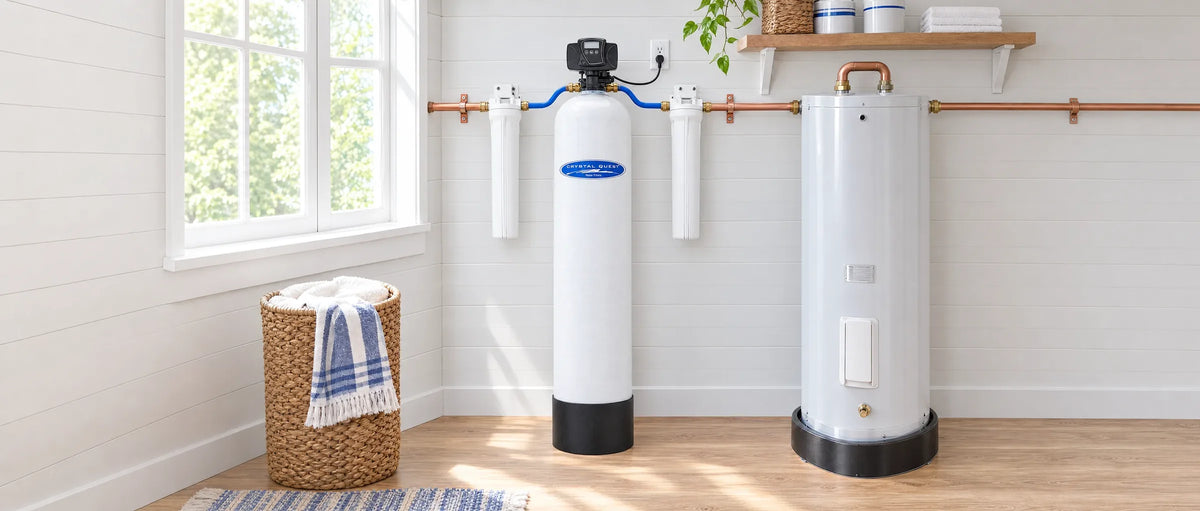
Crystal Quest whole house water softener system installed in home utility room - premium ion exchange technology for hard water treatment
Best Water Softener Systems

Whole House Water Softener Systems

Spot-free dishes. Softer skin and hair. Appliances that last. Stop limescale damage and protect your home from hard water buildup with a Crystal Quest water softener.

Free Shipping Over $150
Performance Guarantee
Expert Support
Made in USA

Filter products

The highest price is $2,639.00
$
$

Benefits of a Water Softener

Hard water causes more problems than you might realize—from spotty dishes and dry skin to limescale-clogged pipes and shortened appliance lifespans. A water softener eliminates these issues, protects your home, and saves you money.

How a Water Softener Works

A water softener removes calcium and magnesium through ion exchange, replacing hard minerals with sodium ions. The result? Soft water delivered to every faucet in your home—protecting your plumbing, appliances, and family.

Buy a Water Softener
Vibrant laundry with brighter colors and whiter whites washed with softened water - clothes stay softer longer

Vibrant Laundry

Whiter whites, brighter colors, and soft fabrics using 50% less detergent per load.

Spot-free dishes and crystal clear glassware washed with softened water - no water spots or mineral film

Spot-Free Shine

Eliminate the cloudy mineral film on glassware and silverware forever.

Healthier skin, nails and silky hair from bathing with soft water - reduces dryness and irritation

Healthier Skin & Hair

Say goodbye to dry, tight skin and brittle hair caused by hard water mineral residue.

Clean faucet free of limescale and hard water buildup - water softener prevents mineral deposits on fixtures

Clean Plumbing

Prevent scale that clogs pipes, reduces shower pressure, and leaves behind white spots.

Longer lasting appliances protected from scale buildup - water softener extends life of water heaters and dishwashers

Longer Appliance Life

Protect water heaters and dishwashers from premature burnout caused by scale buildup.

How to Choose the Right Size Water Softener

Choosing the right size water softener doesn't have to be complicated. The key factors are your home's water hardness level, daily water usage, and household size. A properly sized system ensures efficient operation, lower salt usage, and soft water throughout your entire home. Use our water hardness converter to understand your water test results.

Find the perfect water softener size for your home.

Water softener sizing quiz - find the perfect system for your home based on household size and water hardness

Perfect Fit Guarantee

We'll help you find the right size for your home

Water Softener Sizing Guide

Correct sizing is critical for efficiency. An undersized system will run out of soft water, while an oversized system wastes salt and water. Use our tools below to find your perfect match.

Water Softener Sizing Calculator

Well water often contains iron which affects sizing requirements.
Don't know? Check your water bill or view the hardness map
Select the number of people who regularly use water in your home.
More bathrooms require higher flow rates.
--
--

Need help? If you're unsure about your water hardness or have complex water issues, request a free consultation from our experts.

1. Determine Your Water Hardness

The first step in sizing a water softener is knowing your hardness level in Grains Per Gallon (GPG). If your water test report gives you results in Parts Per Million (PPM) or mg/L, you will need to convert it.

You can use our Water Hardness Calculator for an exact conversion, or check our US Water Hardness Map for regional estimates.

Pro Tip

If you are on a private well, we strongly recommend a laboratory water analysis. Iron and manganese compete with hardness minerals, meaning you may need a larger system than the standard calculation suggests.

2. Calculate Grain Capacity

The "Grain Capacity" (e.g., 48,000 grains) refers to how much hardness the resin tank can remove before it needs to regenerate (clean itself).

System Size Grain Capacity Household Size Hardness Range
1.5 Cu Ft 48,000 Grains 1-4 people Up to 25 GPG
2.0 Cu Ft 60,000 Grains 5+ people Up to 40 GPG

3. When to Go Commercial

For extremely hard water (over 40 GPG) or large estates with high flow rates, a residential unit may cause pressure drops. In these cases, we recommend a Commercial Water Softener or a Whole House Reverse Osmosis system to handle the load without sacrificing water pressure.

Compare Water Softener Systems

Deciding between the standard and high-capacity models? See the specifications side-by-side to make the right choice for your home.

Feature
Crystal Quest 1.5 Cubic Foot Whole House Water Softener - 48,000 grain capacity standard system
Standard Capacity
1.5 Cu Ft System
Best Seller Crystal Quest 2.0 Cubic Foot Whole House Water Softener - 60,000 grain capacity high-capacity system - best seller
High Capacity
2.0 Cu Ft System
Household Size 1-4 People 5+ People
Grain Capacity 48,000 Grains 60,000 Grains
Resin Volume 1.5 Cubic Feet 2.0 Cubic Feet
Flow Rate 12 GPM 14 GPM
High-Efficiency Meter Valve
8% Crosslink Resin
Bypass Valve Included
$1,531 Configure This System $1,633 Configure This System

Customers Love Crystal Quest Water Softeners

Real reviews from homeowners who have transformed their water quality with Crystal Quest water softeners.

Average Rating
30+
Verified Reviews
30+
Years in Business
Hannah
Verified Buyer

"This is the cadillac of filtration systems. We purchased this to filter our well water (22 GPG hardness) and it has helped tremendously. Prior to having filtration, we were pumping through faucet fixtures like crazy due to the hardness of our water. After 8 months with this system, we've already saved on two faucet replacements. This system has completely reversed that trend."

Purchased: Whole House Water Softener
Erica
Verified Buyer

"Awesome filtration unit with all the capacity that we need for our family of 5. Our softener was pretty outdated (15+ years old) so we updated that as well and it is surprisingly more compact than our old one. We are sitting on a well so we did not have a ton of filtration options. Glad we ran into this one—installed in about 2 hours."

Purchased: Whole House Water Softener
Ellie
Verified Buyer

"We replaced an old Whirlpool unit with this and it is working out perfectly. The old system was bulky and this is saving us a ton of space in our utility room. The install was seamless and we completed it in under an hour. No more white spots on our glassware!"

Purchased: Whole House Water Softener
Debbie S.
Verified Buyer

"The unit was installed about two weeks ago. Thus far I am very pleased with the performance—my shower pressure is noticeably better and my hair feels softer. Additionally, the salesperson Raquel was extremely helpful when we had questions during the installation process, and she walked us through our issues. Y'all should give her a raise for her professionalism and patience."

Purchased: Whole House Water Softener
Water softener maintenance - Woman holding replacement filter cartridges for optimal system performance

Water Softener Maintenance

Keeping your system running efficiently is easier than you think. Our experts answer the most common questions about salt, service, and system longevity—to read more click here.

How often do I need to add salt to the tank?

Check your brine tank once a month. When the salt level drops below the water level (or is less than 1/3 full), simply add a bag of high-purity salt pellets. Most households refill every 6-8 weeks depending on water usage.

What is a salt bridge and how do I fix it?

A salt bridge is a hard crust that forms in the tank, creating an empty space between the salt and the water. If your tank is full but your water feels hard, gently poke the salt with a broom handle to break up the crust and allow the salt to drop down.

Do I need to clean the brine tank?

Yes, we recommend cleaning the brine tank once every 12-18 months. Let the salt level run low, remove any remaining salt, and rinse the tank with a garden hose to remove sediment or sludge buildup before refilling.

How long does the resin last?

Crystal Quest systems use premium 8% crosslink resin designed to last 15-20 years with proper care. Using a resin cleaner annually can help strip iron deposits and extend the life of the media even further.

How often does a water softener need to regenerate?

Most water softeners regenerate every 2-7 days depending on water hardness, household size, and water usage. Modern demand-initiated systems regenerate only when needed based on actual water consumption, which saves salt and water. Use our regeneration calculator to find the ideal schedule for your home.

Do I need a professional to install my water softener?

We recommend having a licensed plumber install your water softener to ensure proper setup and compliance with local plumbing codes. Professional installation also helps protect your warranty and ensures optimal system performance. Our technical support team is available to assist your plumber with any questions during the installation process.
Maintenance-Free Solution

Looking for a Water Softener Alternative?

Prevent scale buildup without salt bags, electricity, or drainage. Explore our eco-friendly Salt-Free Water Conditioners for a hassle-free hard water solution.

Shop Salt-Free Systems

Water Softener Questions & Answers

Expert answers to your most common water softener questions—everything you need to know before buying

A water softener works through a process called ion exchange. Here's what happens inside:

  • Hard water enters the mineral tank filled with resin beads
  • Resin beads have a negative charge and are saturated with sodium ions
  • Calcium and magnesium ions (the hardness minerals) are positively charged and attracted to the resin
  • The minerals swap places with sodium ions on the beads
  • Soft water exits the tank and flows throughout your home

The Regeneration Cycle:

When the resin beads become saturated with hardness minerals, the softener regenerates. A concentrated salt brine solution flushes through the tank, recharging the beads with sodium and washing captured minerals down the drain. Most systems regenerate every 3-7 days depending on water usage.

Learn more in our complete guide: How Do Water Softeners Work?

Yes, a water softener is worth it if you have hard water (7+ grains per gallon). About 85% of American homes have hard water, making softeners one of the most valuable home improvements.

Financial Benefits:

  • Extended appliance lifespan: Water heaters, dishwashers, and washing machines last 30-50% longer
  • Reduced energy costs: Scale-free water heaters operate up to 29% more efficiently
  • Less soap and detergent: Use up to 50% less cleaning products
  • Fewer plumbing repairs: No scale buildup means no clogged pipes
  • Annual savings: Typically $500+ per year on soap, energy, and appliance repairs

Quality of Life Benefits:

  • Softer skin and healthier hair
  • Spot-free dishes and glassware
  • Brighter, softer laundry
  • Cleaner fixtures without scrubbing

A quality water softener lasts 15-20 years and costs less than $100 annually in salt. The long-term savings far outweigh the initial investment, especially when you factor in appliance replacement costs from hard water damage.

Water softeners and water conditioners both address hard water, but they work differently:

Water Softeners (Salt-Based):

  • Remove calcium and magnesium through ion exchange
  • Replace hardness minerals with sodium
  • Require salt refills (40-80 lbs/month)
  • Produce wastewater during regeneration
  • Provide truly "soft" water that lathers exceptionally
  • Best for very hard water (10+ GPG)

Water Conditioners (Salt-Free):

  • Don't remove minerals—change their structure instead
  • Use Template Assisted Crystallization (TAC) technology
  • No salt, no electricity, no wastewater
  • Virtually maintenance-free
  • Keep beneficial minerals in your water
  • Best for moderate hardness (4-8 GPG)

Choose a Softener If: You have very hard water, want maximum scale prevention, or prefer that "soft water feel."

Choose a Conditioner If: You want to keep minerals, prefer zero maintenance, or live where salt-based softeners are restricted.

For a detailed comparison, read our guide: Water Softener vs. Salt-Free Conditioner

To size a water softener correctly, calculate your daily softening demand:

Simple Formula:
(Number of People) × (80 gallons/day) × (Water Hardness in GPG) = Daily Grain Requirement

Example: Family of 4 with 10 GPG hardness
4 × 80 × 10 = 3,200 grains per day

Recommended Grain Capacities:

  • 1-2 people: 32,000 grains (1.0 cubic foot)
  • 3-4 people: 40,000-48,000 grains (1.5 cubic feet)
  • 5-6 people: 48,000-64,000 grains (2.0 cubic feet)
  • 6+ people: 64,000+ grains (2.5+ cubic feet)

Important Adjustments:

  • Add 5 GPG for every 1 ppm of iron in your water
  • Choose a system that regenerates every 5-7 days for optimal efficiency
  • Don't oversize—an oversized system wastes salt and may not regenerate frequently enough

Use our water softener size calculator for a personalized recommendation, or our water hardness converter to understand your water test results.

A water softener typically uses 40-80 pounds of salt per month for an average family of four with moderately hard water (7-10 GPG). This equals roughly one 40-pound bag monthly.

Factors That Affect Salt Usage:

  • Water hardness: Higher hardness = more salt needed
  • Household size: More people = more water = more regeneration
  • Iron content: Water with iron (2+ ppm) requires more frequent regeneration
  • System efficiency: High-efficiency systems use 25-50% less salt
  • Regeneration settings: Metered systems regenerate only when needed

Salt Usage by Household:

  • 1-2 people: 20-40 lbs/month
  • 3-4 people: 40-80 lbs/month
  • 5+ people: 80-120 lbs/month

Cost: At $6-8 per 40-pound bag, monthly salt costs typically run $6-16 for most families.

Yes, soft water is safe to drink for most people. The ion exchange process simply swaps hardness minerals for small amounts of sodium.

Sodium Content in Soft Water:

  • Typical soft water contains 20-30 mg sodium per 8 oz glass
  • That's less than a slice of bread (80-230 mg)
  • Far less than most processed foods

For Sodium-Restricted Diets:

  • Use potassium chloride instead of sodium chloride as your softening salt
  • Install a reverse osmosis system at your kitchen tap for drinking/cooking water
  • Leave one cold water tap (usually kitchen) unsoftened
  • Consult your healthcare provider about your specific sodium limits

For Cooking: Soft water is actually preferred for cooking—it doesn't leave mineral deposits and allows foods to cook more evenly. Coffee and tea taste better, and baked goods rise more consistently.

Check your salt level once or twice per month and add salt when the level drops below one-third full. Most families add salt every 6-8 weeks.

Proper Salt Levels:

  • Keep the brine tank at least one-quarter full at all times
  • Salt should be 3-4 inches above the water level
  • Don't overfill—leave room for salt to dissolve properly

Signs You Need to Add Salt:

  • Water feels hard (doesn't lather well)
  • You can see the water level in the brine tank
  • Salt level is below one-third full
  • Spotting returns on dishes and glassware

Pro Tip: Set a monthly reminder to check your salt level. Consistent maintenance keeps your softener running efficiently and extends its lifespan.

For complete care instructions, see our water softener maintenance guide.

No, a properly operating water softener will not damage your septic system. In fact, research shows it may actually help.

What the Research Shows:

  • A 2013 Water Quality Association study found softener discharge causes no operational problems in septic systems
  • University of Wisconsin research found soft water can increase biological performance in septic tanks
  • Calcium and magnesium from regeneration can improve soil percolation in drain fields

Water Volume Is Minimal:

  • Regeneration releases only about 50 gallons slowly over time
  • That's less than a washing machine cycle
  • Modern high-efficiency softeners use even less

For Extra Peace of Mind:

  • Use potassium chloride instead of sodium chloride
  • Ensure your softener is properly sized and efficient
  • Avoid extremely inefficient softeners that regenerate too frequently

A quality water softener typically lasts 15-20 years with proper maintenance. Some premium systems can last 25-30 years.

Component Lifespans:

  • Resin beads: 15-20+ years (rarely need replacement)
  • Control valve: 15-20 years
  • Brine tank: 20+ years
  • Mineral tank: 20+ years

Factors That Affect Lifespan:

  • Water quality: High iron or chlorine degrades resin faster
  • Proper sizing: Undersized units work harder and wear faster
  • Maintenance: Regular salt refills and occasional cleaning
  • Build quality: Premium components last longer

Signs Your Softener Needs Replacement:

  • Water feels hard despite proper salt levels
  • System not regenerating on schedule
  • Frequent repairs needed
  • Over 15 years old with declining performance
  • Salt usage has increased significantly

If you notice several of these signs of hard water, you would likely benefit from a water softener:

Around Your Home:

  • White crusty buildup (limescale) on faucets, showerheads, and around drains
  • Spotty or cloudy dishes and glassware even after washing
  • Soap scum that's hard to remove from tubs and showers
  • Reduced water pressure from mineral buildup in pipes
  • Water heater making rumbling or popping sounds

Personal Effects:

  • Dry, itchy skin after showering
  • Dull, brittle hair that's hard to manage
  • Soap doesn't lather well
  • Stiff, scratchy laundry with fading colors

Appliance Issues:

  • Dishwasher and washing machine need frequent repairs
  • Water heater inefficiency or early failure
  • Coffee makers and kettles with heavy mineral deposits

Read our full guide: 10 Common Signs of Hard Water

Many homeowners with basic plumbing skills can install a water softener themselves, though professional installation ensures optimal performance.

DIY Installation Requirements:

  • Connect to main water line (after water meter, before water heater)
  • Install bypass valve for maintenance
  • Run drain line to floor drain or utility sink
  • Provide electrical outlet for control valve
  • Basic tools: pipe wrenches, tubing cutter, Teflon tape
  • Time: 3-4 hours for experienced DIYers

Consider Professional Installation If:

  • You're not comfortable with plumbing work
  • Local codes require permits or inspections
  • You have complex plumbing (multiple water heaters, loops)
  • You want to ensure warranty protection
  • Your water line is PVC, galvanized, or copper requiring specialized connections

Professional Installation: Typically costs $200-$500 and ensures proper sizing, placement, and programming for your specific water conditions.

Standard water softeners can remove low levels of ferrous (clear water) iron—typically up to 2-3 ppm. However, for higher iron levels or ferric iron, you'll need additional treatment.

Types of Iron in Water:

  • Ferrous iron (clear water iron): Dissolved, water appears clear but turns orange when exposed to air—softeners can handle up to 2-3 ppm
  • Ferric iron (red water iron): Already oxidized, visible rust particles—requires a dedicated iron filter
  • Iron bacteria: Slimy orange buildup—requires specialized treatment

Signs of Iron in Your Water:

  • Orange or rust staining on fixtures, toilets, and laundry
  • Metallic taste
  • Reddish-brown sediment
  • Orange slime in toilet tanks

Best Solution for High Iron: Pair your water softener with a dedicated iron removal system installed BEFORE the softener. This protects your softener resin and ensures complete iron removal.

Use high-purity water softener salt for best results. Here are your options:

Salt Types (Best to Basic):

  • Evaporated salt pellets (99.9% pure): Highest quality, least residue, dissolves consistently—recommended
  • Solar salt crystals (99.6% pure): Good quality, more affordable, may leave minor residue
  • Rock salt (95-99% pure): Cheapest option, but contains insoluble impurities that accumulate in the brine tank
  • Potassium chloride (salt-free alternative): Costs 2-3x more but ideal for sodium-restricted diets and septic systems

Important Tips:

  • Never use table salt, ice melt, or de-icing salt
  • Don't mix different salt types in the same tank
  • Pellets vs crystals: Pellets dissolve more consistently and are less likely to form salt bridges
  • For high-efficiency softeners: Use evaporated salt pellets

Avoid Salt Bridges: Don't let humidity enter the brine tank, and break up any hard crust that forms on top of the salt.

Soft water feels slippery because soap actually works properly and rinses completely, leaving your natural skin oils intact.

What's Really Happening:

  • Hard water: Calcium and magnesium react with soap to form soap scum—a filmy residue that stays on your skin
  • This residue makes you feel "squeaky clean"—but you're actually coated in soap residue
  • Soft water: Soap lathers fully and rinses completely away
  • The "slippery" feeling is actually your skin's natural moisture

Benefits of This "Slippery" Feeling:

  • Skin stays naturally moisturized
  • Hair is softer and more manageable
  • No soap residue clogging pores
  • Less need for lotions and conditioners

Adjustment Period: Most people adjust to soft water within 1-2 weeks. You can also use less soap—soft water requires about 50% less soap and shampoo to achieve the same clean.

Crystal Quest water softeners include comprehensive warranty coverage that reflects our confidence in their durability:

Warranty Coverage:

  • Mineral Tank & Brine Tank: Lifetime warranty
  • Control Valve: 5-year warranty
  • Resin: 10-year warranty

What's Covered:

  • Manufacturing defects
  • Component failures under normal residential use
  • Performance issues related to materials or workmanship

How to File a Warranty Claim:

  • Contact our customer support team
  • Have your order number and proof of purchase ready
  • Describe the issue you're experiencing

Performance Guarantee: If you're not satisfied with your water quality, our experts will work with you to diagnose and resolve any issues.

Not Sure Which System Is Right for You?

Every home's water is different. Tell us about your situation and our experts will recommend the perfect water softener for your needs—no guesswork required.

  • Free personalized system recommendation
  • Help with sizing for any home size
  • Solutions for city water and well water
  • Response within 1-2 business days

Prefer to Talk?

Our water experts are happy to walk you through your options and answer any questions.

Get Your Free Recommendation

Tell us about your water and we'll recommend the right system for your home.