Crystal Quest water filtration systems that remove microplastics from drinking water
Microplastic Water Filtration

Water Filters That Remove Microplastics

Tiny plastic particles are invading your tap water, your bottled water, and your body. Crystal Quest reverse osmosis systems filter out microplastics as small as 0.0001 microns, contaminants no pitcher filter can touch, for fresh pure water on demand at any tap. Made in the USA with over 30 years of filtration expertise.

Removes Microplastics
Free Shipping Over $150
Made in USA
Expert Support
30+ Years Experience

Microplastics Are in Your Water. All of It.

Microscopic plastic particles have been found in tap water, bottled water, and even human blood. They don’t break down—and standard filters miss the smallest ones entirely.

Person drinking water that may contain microplastic particles

What Microplastics Do to Your Body

  • Organ accumulation: Found in lungs, liver, kidneys, and placenta tissue
  • Hormone disruption: Carry endocrine-disrupting chemicals like BPA and phthalates
  • Inflammation: Studies link microplastic exposure to gut and systemic inflammation
  • Cardiovascular risk: Recent research found microplastics in arterial plaque
  • In your blood: Nearly 80% of people tested had measurable microplastics in their bloodstream
240K+ Particles Per Year Estimated microplastic particles ingested annually by the average American
Close-up of water highlighting invisible microplastic contamination
93% Of Bottled Water Contains microplastics—up to 2x more than tap water in some studies
0.0001µm RO Membrane Pore Small enough to block even nanoplastics invisible to the naked eye

Microplastic Filtration Systems

Browse reverse osmosis and multi-media filtration systems designed to remove microplastics from your drinking water.

Filter products
The highest price is $10,088.00
$
$

10 Products

Best Water Filters for Microplastic Removal by Installation Type

Reverse osmosis is the most effective technology for removing microplastics from drinking water. Choose the installation type that fits your home.

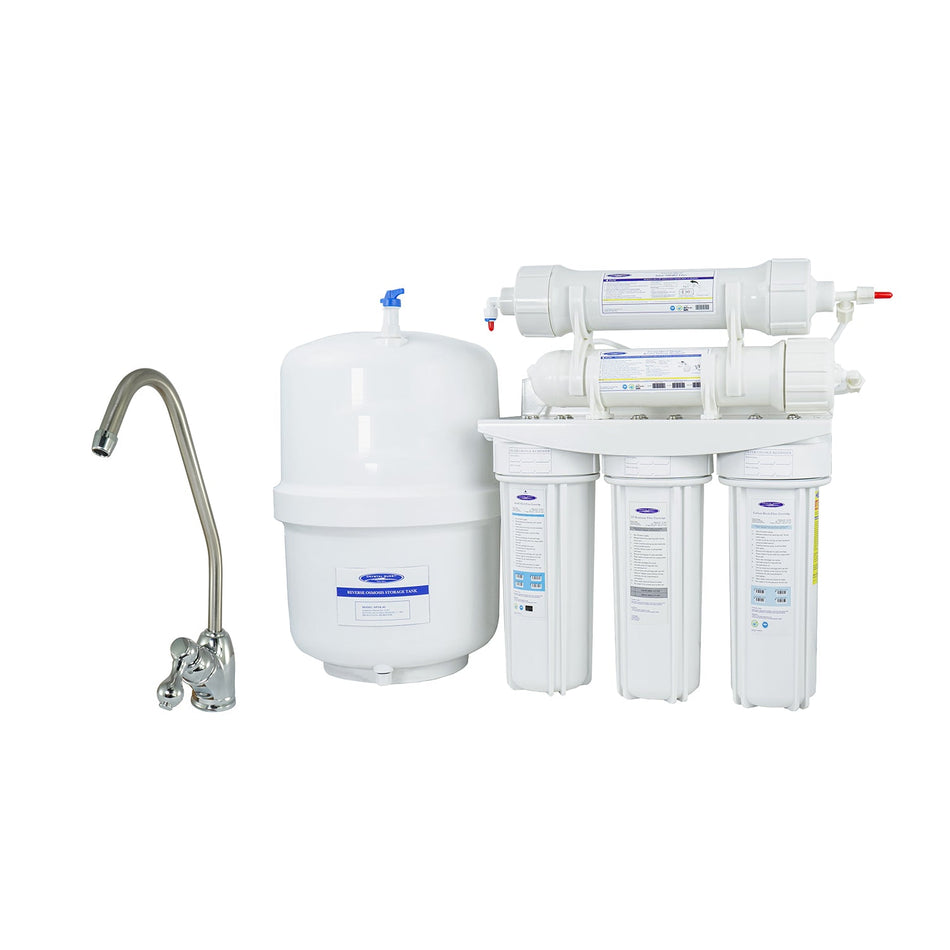
Crystal Quest Thunder under-sink reverse osmosis system for microplastic removal
Most Popular

Under-Sink Reverse Osmosis (Thunder Series)

The Thunder series is our most popular solution for families concerned about microplastics. The RO membrane’s pore size (0.0001 microns) is thousands of times smaller than even the tiniest microplastic particle—nothing gets through. Multi-stage filtration also handles PFAS, lead, chlorine, and dozens of other contaminants.

  • Removes microplastics down to the nanoplastic range
  • Multiple configurations from 6 to 14+ stages for additional contaminant targeting
  • Compact design fits under standard kitchen sinks with dedicated faucet included

Starting at: $298  |  Best for: Kitchen drinking water & cooking

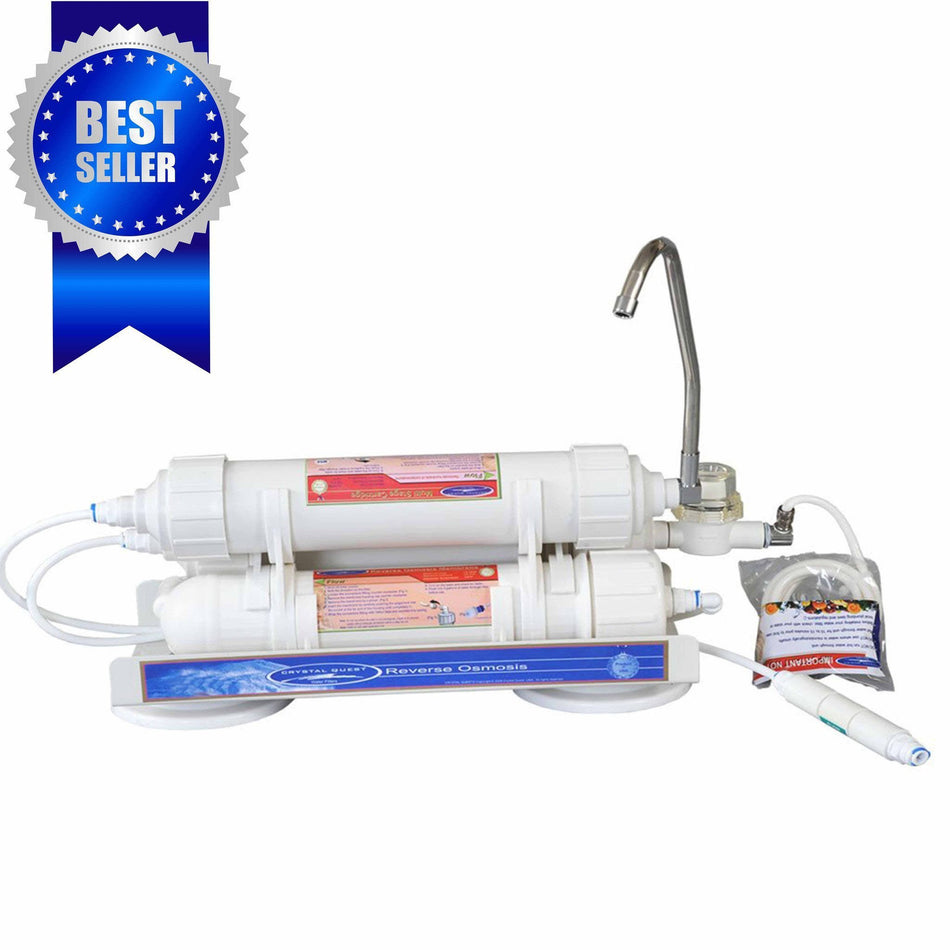
Crystal Quest countertop reverse osmosis system for portable microplastic removal
No Installation Required

Countertop Reverse Osmosis

Can’t modify your plumbing? The countertop RO connects directly to your faucet—no drilling, no permanent changes. Same membrane technology that blocks microplastics and nanoplastics, in a portable format that goes anywhere you do.

  • Portable microplastic protection—ideal for renters and apartments
  • Connects to any standard faucet in minutes, no tools needed
  • Same RO membrane technology as our under-sink systems

Price: $202  |  Best for: Renters, apartments, portable use

Crystal Quest whole-house reverse osmosis system for complete home microplastic protection
Whole-Home Protection

Whole-House Reverse Osmosis

For families who want microplastic-free water at every tap, shower, and appliance. Treats your entire water supply before it enters your plumbing—so you’re not just filtering what you drink, but what you cook with, bathe in, and wash your clothes with.

  • Every faucet, shower, and appliance gets microplastic-free water
  • Systems available from 600 GPD to 6,000+ GPD for any home size
  • Includes pre-filtration, RO membrane, storage tank, and UV options

Starting at: $2,227  |  Best for: Complete home microplastic protection

SMART Multi-Media Filtration for Microplastic Reduction

Don’t need full reverse osmosis? Our SMART series uses multi-stage carbon and media filtration to reduce larger microplastic particles while targeting chlorine, VOCs, heavy metals, and more.

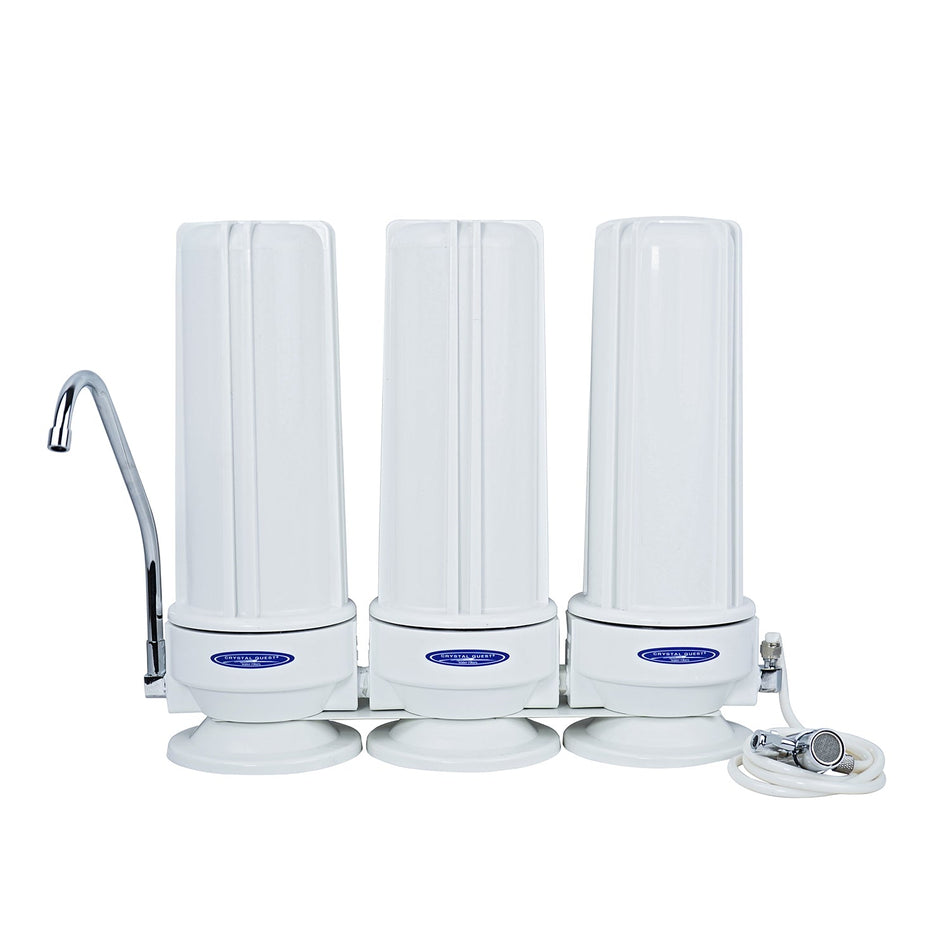
Crystal Quest SMART series whole house water filter
Whole House

Whole House SMART Filters

Multi-media whole house filtration for every tap. Catalytic and coconut shell GAC stages capture larger microplastic particles alongside chlorine, VOCs, and heavy metals throughout your entire home.

Starting at: $309  |  Best for: Whole-home multi-contaminant protection

Browse Whole House SMART
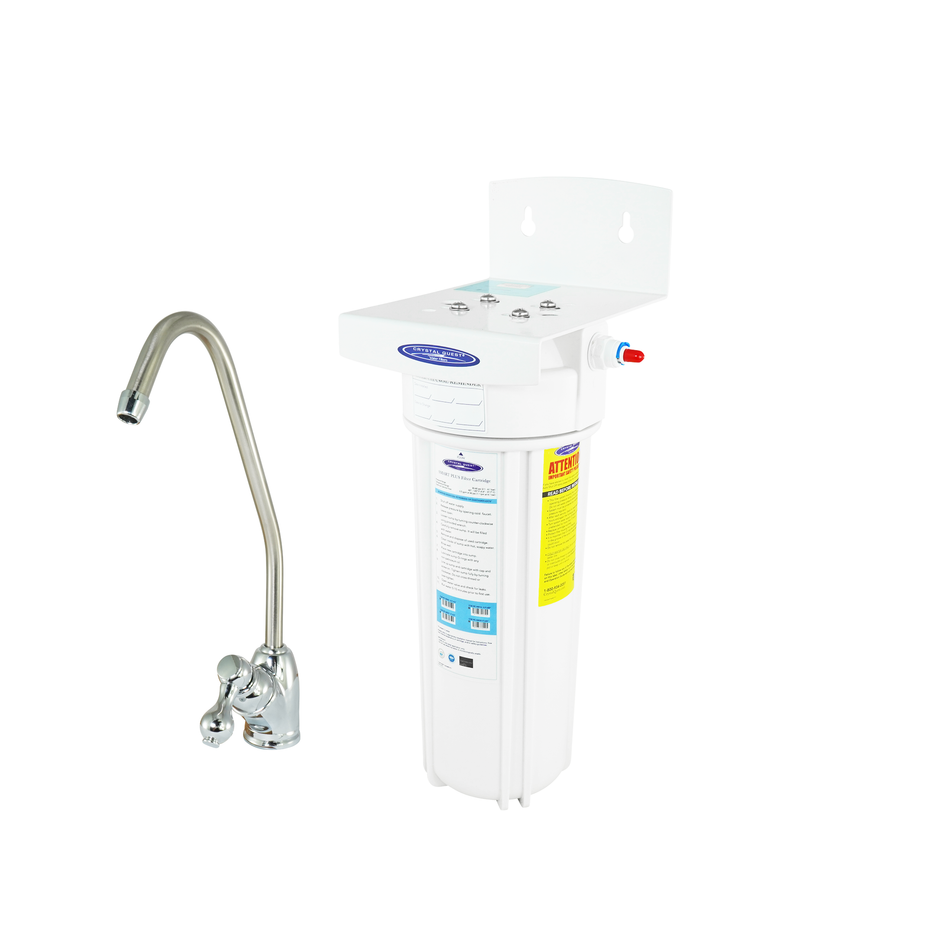
Crystal Quest SMART series under-sink water filter
Under-Sink

Under-Sink SMART Filters

Compact multi-media filtration under your kitchen sink. No RO wastewater, faster flow rate. Available in single, double, and triple cartridge configurations for your water quality needs.

Starting at: $149  |  Best for: Kitchen water without RO

View Under-Sink SMART
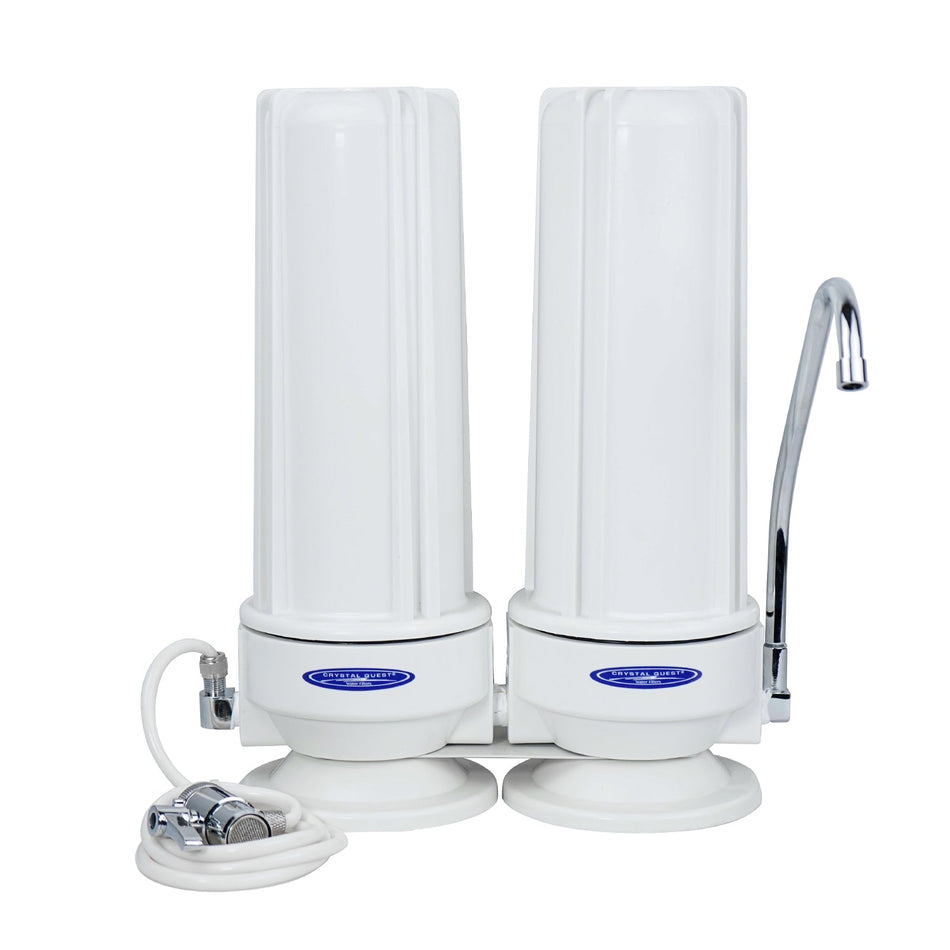
Crystal Quest SMART series countertop water filter
Countertop

Countertop SMART Filters

Portable multi-media filtration that connects to your faucet in minutes. No installation, no plumbing changes. Great for renters who want microplastic reduction without the commitment of RO.

Starting at: $86  |  Best for: Renters, budget-friendly option

View Countertop SMART

Which Filtration Technology Removes Microplastics Best?

Microplastics are physical particles—removal depends on filter pore size. Here’s how the main technologies compare, and why reverse osmosis leads the field for microplastic filtration.

Technology Pore Size Microplastic Removal Best For Limitations
Reverse Osmosis (RO) 0.0001 µm 99%+ (all sizes) Maximum microplastic & nanoplastic removal; also handles PFAS, lead, chlorine, and 50+ contaminants Produces some wastewater; slower flow rate than carbon-only systems
Ultrafiltration (UF) 0.01–0.1 µm 99%+ (particles >0.1µm) Excellent microplastic removal; retains minerals; no wastewater Does not remove dissolved chemicals (PFAS, lead, chlorine); misses smallest nanoplastics
SMART/Eagle Multi-Media 1–5 µm (sediment) + adsorption Reduces larger microplastics Broad multi-contaminant protection (chlorine, VOCs, heavy metals) with microplastic reduction for larger particles Carbon adsorption captures some particles but pore size is larger than RO/UF; best paired with RO for full coverage
Activated Carbon (GAC) 1–50 µm Partial (larger particles only) Chlorine, taste, odor removal; catches some larger microplastic particles Pore size too large for most microplastics (<5µm); no nanoplastic removal; performance varies by carbon quality
Standard Pitcher Filters 20–50+ µm Minimal Basic taste improvement; chlorine reduction Pore size far too large for microplastics; independent tests show most pitcher filters miss the majority of plastic particles

Crystal Quest recommendation: For comprehensive microplastic and nanoplastic removal, reverse osmosis is the clear winner. Our RO systems include multi-stage pre-filtration (including SMART-multi-media and sediment stages) that catch larger particles before water reaches the membrane, providing you with advanced, layered protection.

How Small Are Microplastics? (And What Actually Filters Them)

Microplastics range from 1 to 5,000 microns. Nanoplastics are even smaller. Here’s how particle sizes compare to filter pore sizes—and why most filters miss the smallest ones.

Particle Sizes
Human HairFor reference
70 µm
70 µm
Grain of SandVisible to eye
500 µm
62–500 µm
Large MicroplasticVisible fragments & fibers
100–5000 µm
100–5,000 µm
Small MicroplasticInvisible to naked eye
1–100 µm
1–100 µm
NanoplasticsCrosses cell membranes
<1 µm
<1 µm
Filter Pore Sizes
Pitcher FiltersBrita, PUR, ZeroWater class
20–50 µm
20–50 µm
Activated CarbonStandard GAC filters
1–50 µm
1–50 µm
UltrafiltrationUF membrane
0.01–0.1 µm
0.01–0.1 µm
Reverse OsmosisCrystal Quest RO membrane
0.0001 µm
0.0001 µm

The takeaway: Most pitcher filters can’t catch microplastics smaller than 20 microns. The smallest, most dangerous microplastics and nanoplastics are under 1 micron—only reverse osmosis (0.0001 µm pore size) reliably filters them all.

Why Families Choose Crystal Quest for Microplastic Removal

Over 30 years of water filtration expertise, engineered and assembled in the USA.

Family enjoying clean microplastic-free water from Crystal Quest filtration system

Filters Down to 0.0001 Microns

Our RO membranes have pores thousands of times smaller than the tiniest microplastic particle. Even nanoplastics that cross cell membranes can’t pass through, no pitcher filter comes close to this level of removal.

Multi-Contaminant Protection

Microplastics aren’t the only concern. Our multi-stage systems also remove PFAS, lead, chlorine, arsenic, pharmaceuticals, and dozens of other contaminants in a single unit. One system, comprehensive protection.

Made in the USA

Every Crystal Quest system is engineered and assembled in our U.S. facility. Our ISO 9001 certified manufacturing process means consistent quality, no shortcuts, no mystery in quality.

Systems for Every Situation

From a single kitchen faucet to your entire house, under-sink, countertop, and whole-house systems let you match the right level of protection to your situation and budget. Renters, homeowners, and large families all covered.

Real Expert Support

Not sure which system fits your water? Our team has helped over hundreds of thousands of people find the right solution for their needs. Call us for free, personalized guidance from real people who understand water chemistry.

Free Shipping on Orders Over $150

Most microplastic filtration systems qualify automatically. Shipping is on us for orders over $150 within the continental U.S. If it’s not the right fit, our return policy makes exchanges hassle-free.

Frequently Asked Questions About Microplastic Water Filters

Expert answers to the most common questions about microplastics in drinking water and how to filter them

Yes, but effectiveness varies dramatically by filter type:

  • Reverse osmosis: Removes 99%+ of all microplastic sizes, including nanoplastics
  • Ultrafiltration: Removes 99%+ of particles larger than 0.1 microns
  • Activated carbon: Catches some larger particles but misses the smallest
  • Pitcher filters: Pore sizes (20–50µm) too large for most microplastics

The key factor is pore size. Microplastics range from 1 to 5,000 microns, and the most concerning nanoplastics are under 1 micron. Only RO (0.0001µm) reliably filters the full range. Learn more about how RO removes microplastics.

Yes—RO is the most effective residential technology for microplastic removal. The membrane pores are 0.0001 microns, which is thousands of times smaller than even the tiniest microplastic particle.

To put that in perspective: if a human hair is a highway, an RO membrane pore is a crack in the sidewalk. Microplastics and nanoplastics simply cannot pass through.

Crystal Quest RO systems also remove PFAS, lead, chlorine, and dozens of other contaminants simultaneously.

Not reliably. A 2024 study in Environmental Science & Technology Letters found that boiling hard water can cause some microplastics to clump with calcium carbonate, making them easier to strain out. However, boiling does not remove microplastics on its own—it can actually concentrate them as water evaporates.

For consistent, verified microplastic removal, a reverse osmosis system is the recommended approach. It doesn’t depend on water chemistry or boiling conditions.

Yes. A widely cited 2018 study found microplastics in 93% of bottled water tested across 11 major brands, with an average of 325 particles per liter. Some brands contained up to twice the microplastic levels found in tap water.

The plastic bottles themselves are a primary source—heat, sunlight, and time cause the plastic to shed particles into the water inside. A home filtration system with a reusable glass or stainless steel bottle is both more effective and more economical long-term.

To remove the full range of microplastics (1–5,000 microns) and nanoplastics (under 1 micron), you need a filter with sub-micron pore size:

  • Reverse osmosis (0.0001 µm): Most effective—blocks everything down to nanoplastics
  • Ultrafiltration (0.01–0.1 µm): Catches most microplastics, may miss smallest nanoplastics
  • Above 5 µm: Misses the majority of microplastic particles

Any filter advertising microplastic removal should list its pore size or micron rating. If it doesn’t, it probably can’t back up the claim.

Most standard pitcher filters are not effective at removing microplastics. Their pore sizes are typically 20–50 microns—far too large to catch the majority of microplastic particles, which can be as small as 1 micron.

Some newer pitcher models claim microplastic reduction, but independent testing consistently shows reverse osmosis and ultrafiltration systems are far more reliable for consistent removal across all particle sizes.

If you’re currently using a pitcher and want real microplastic protection, an under-sink RO system (starting at $298) is the most effective upgrade.

Microplastics enter drinking water from multiple sources:

  • Environmental degradation: Plastic waste breaks down into smaller and smaller particles
  • Synthetic clothing: Washing releases thousands of microfibers per load
  • Tire wear: Road runoff carries tire-derived microplastics into water sources
  • Industrial discharge: Manufacturing processes release plastic particles
  • Plastic pipes and containers: Your plumbing and water storage shed particles over time

Municipal water treatment plants were not designed to filter particles this small. Microplastics pass through conventional treatment and into your tap—which is why point-of-use filtration at home is the most reliable protection.

Yes. Crystal Quest reverse osmosis systems remove both microplastics and PFAS (forever chemicals) in a single unit. The RO membrane blocks microplastics by size (0.0001µm pores) while rejecting dissolved PFAS compounds at 95–99%+ rates.

Multi-stage pre-filtration with catalytic and coconut shell GAC provides additional contaminant removal. This makes Crystal Quest RO systems a comprehensive solution for families concerned about both microplastics and PFAS—no need for separate systems.

Not reliably for the full range of microplastic sizes. ZeroWater uses a 5-stage ion exchange filter that outperforms standard Brita and PUR pitchers for dissolved solids (TDS reduction). However, ZeroWater is not independently certified for microplastic removal, and its pore size is still significantly larger than the smallest microplastics and nanoplastics.

While ZeroWater may capture some larger microplastic particles, for consistent removal across all sizes—especially nanoplastics under 1 micron that cross cell membranes—a reverse osmosis system (0.0001µm pore size) is the most effective upgrade. Crystal Quest offers countertop RO starting at $202 with no installation required.

Not Sure Which Microplastic Filter Is Right for You?

Every home’s water is different. Tell us about your situation and our experts will recommend the right system—no guesswork required.

  • Free personalized system recommendation
  • Help choosing between RO and SMART systems
  • Under-sink, countertop, or whole-house sizing
  • Response within 1–2 business days

Prefer to Talk?

Our water experts are happy to walk you through your options and answer any questions.

Get Your Free Recommendation

Tell us about your water and we’ll recommend the right system for your home.

The Complete Guide to Choosing a Microplastic Water Filter

If you’ve been researching microplastic water filters, you’re not alone. Studies showing plastic particles in tap water, bottled water, and even human blood have driven a surge of interest in home filtration. But with so many filter types on the market—pitchers, faucet mounts, under-sink systems, whole-house units—figuring out which one actually removes microplastics can be confusing.

This guide covers what microplastics are, why they matter, and how to choose a filter that genuinely works.


What Are Microplastics and Where Do They Come From?

Microplastics are tiny plastic fragments measuring between 1 and 5,000 microns (5 millimeters). Nanoplastics are even smaller—under 1 micron—and are the most concerning because they’re small enough to cross cell membranes and enter your bloodstream.

They enter drinking water from everywhere: degrading plastic waste in the environment, synthetic clothing fibers released during laundry, tire wear on roads, industrial discharge, and even the plastic pipes used to transport water to your home. Municipal treatment plants were never designed to catch particles this small, so they pass right through into your tap.

A USGS study found microplastics in tap water samples from across the United States. And bottled water is no safer—research has found that 93% of bottled water contains microplastics, sometimes at concentrations double that of tap water. The bottles themselves shed particles into the water inside, especially when exposed to heat or sunlight.

Health Concerns: Why Microplastics in Water Matter

Research into the health effects of microplastic ingestion is still emerging, but what we know so far is concerning. Studies have linked microplastic exposure to:

  • Organ accumulation—microplastics have been found in human lungs, liver, kidneys, and placenta tissue
  • Endocrine disruption—plastics carry chemicals like BPA and phthalates that interfere with hormone function
  • Gut inflammation—animal studies show microplastic ingestion triggers inflammatory responses in the digestive system
  • Cardiovascular risk—a 2024 study published in the New England Journal of Medicine found microplastics in arterial plaque, with patients showing elevated cardiovascular risk

The average American ingests an estimated 240,000+ microplastic particles per year through food and water. Reducing your exposure at the tap—where you have the most control—is one of the most practical steps you can take.

Why Reverse Osmosis Is the Best Filter for Microplastics

Microplastic removal is fundamentally about pore size. The smaller the filter’s pores, the more particles it catches. Reverse osmosis has the smallest pores of any residential filtration technology at 0.0001 microns—thousands of times smaller than even the tiniest microplastic.

To put that in perspective: if a human hair (70 microns) is a highway, an RO membrane pore is a crack in the sidewalk. Microplastics and nanoplastics simply cannot pass through.

Crystal Quest reverse osmosis systems go further with a multi-stage approach:

  • Sediment pre-filtration catches larger particles and protects the membrane
  • Catalytic and coconut shell GAC stages remove chlorine, VOCs, and trap larger microplastics before the membrane
  • High-rejection RO membrane blocks microplastics, nanoplastics, PFAS, lead, and dissolved contaminants
  • Post-filtration polishing for final taste and quality

Choosing the Right System for Your Home

The best microplastic water filter depends on your living situation, budget, and how much protection you want.

For kitchen drinking and cooking water, an under-sink reverse osmosis system is the most popular choice. Crystal Quest’s Thunder series installs beneath your sink with a dedicated faucet, delivering microplastic-free water on demand. Systems start at $298 with configurations from 6 to 14+ stages. Our RO buying guide for beginners can help you compare options.

For renters or portability, our countertop reverse osmosis system ($202) connects to your faucet with no installation. Same membrane technology, no plumbing modifications.

For whole-home protection, a whole-house reverse osmosis system treats every tap, shower, and appliance. Available from 600 GPD to 6,000+ GPD for any home size.

On a tighter budget? Our SMART multi-media systems (starting at $86) use catalytic GAC, coconut shell carbon, and KDF media to reduce larger microplastics while handling chlorine, VOCs, and heavy metals. They won’t match RO for nanoplastics, but they’re a strong step up from a pitcher.

Why Pitcher Filters Fall Short

Standard pitcher filters like those from major consumer brands use granular activated carbon with pore sizes of 20–50 microns. Since the most concerning microplastics are under 5 microns and nanoplastics are under 1 micron, pitcher filters miss the vast majority of particles. Some newer models claim microplastic reduction, but independent testing shows inconsistent results compared to membrane-based systems.

If you’re currently using a pitcher and want genuine microplastic protection, upgrading to an under-sink or countertop RO system is the most impactful change you can make.

Take the First Step Toward Microplastic-Free Water

You can’t control the microplastics in the environment, but you can control what comes out of your tap. A Crystal Quest reverse osmosis system removes microplastics, nanoplastics, PFAS, lead, and dozens of other contaminants—all in one unit, engineered and assembled in the USA.

Not sure where to start? Contact our water specialists for a free consultation. We’ll help you choose the right system for your home, your water, and your budget.