The same water and household run through each tank: days between regenerations, salt and what it costs to run. Choose what matters most and your match follows.
Balanced is what we recommend: the smallest size that does not need to regenerate every few days. Lowest cost accepts a smaller tank that regenerates every 4 to 6 days.
Running costs use $0.24 a pound for salt and the US average of $16.83 per 1,000 gallons for city water and sewer (well and septic: salt only). Your local prices change the dollars, not the size.
Sizing chart
Water softener sizing chart, by people and hardness.
Choose your bathrooms, then find your household and hardness. Each cell shows the size and how often it regenerates at the balanced salt setting. Tap a cell to open it in the calculator.
What size water softener do I need: homes with 1 to 3 tub and shower bathrooms, by household and hardness
Household
5 gpg86 mg/L
10 gpg171 mg/L
15 gpg257 mg/L
20 gpg342 mg/L
25 gpg428 mg/L
30 gpg514 mg/L
1 person
2 people
3 people
4 people
5 people
6 people
7 people
8 people
What size water softener do I need: homes with 4 tub and shower bathrooms, by household and hardness
Household
5 gpg86 mg/L
10 gpg171 mg/L
15 gpg257 mg/L
20 gpg342 mg/L
25 gpg428 mg/L
30 gpg514 mg/L
1 person
2 people
3 people
4 people
5 people
6 people
7 people
8 people
What size water softener do I need: homes with 5 or more tub and shower bathrooms, by household and hardness
Household
5 gpg86 mg/L
10 gpg171 mg/L
15 gpg257 mg/L
20 gpg342 mg/L
25 gpg428 mg/L
30 gpg514 mg/L
1 person
2 people
3 people
4 people
5 people
6 people
7 people
8 people
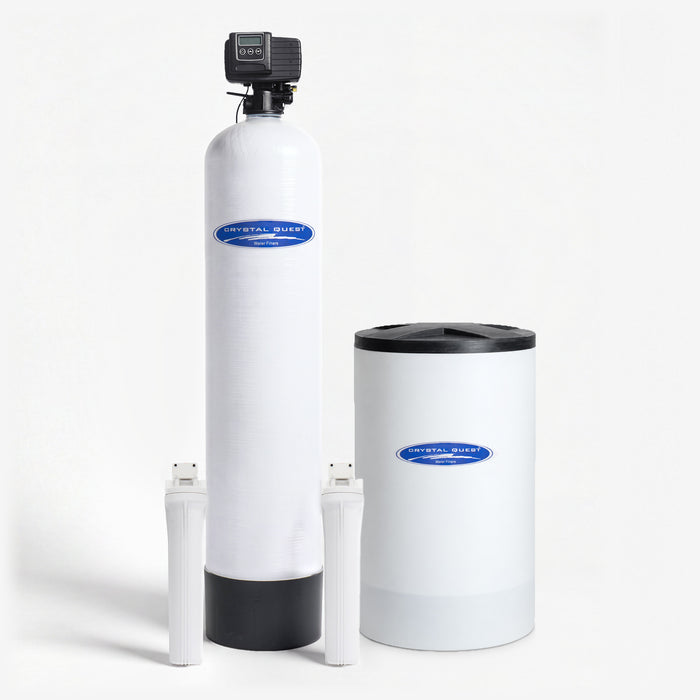
1.5 cu ft, rated 48,000 grains2.0 cu ft, rated 60,000 grains3 cu ft commercial, rated 90,000 grains4 cu ft commercial, rated 120,000 grains
When a bigger tank comes in.
More grainsWhen a tank would regenerate every few days, the next size up runs longer on less salt.
Four tub bathroomsFilling tubs can draw about 12.5 gallons a minute at once, more than a 1.5 cu ft tank is built to pass. The 2.0 is the starting size.
Five or moreThe busiest minute reaches about 14 gallons, more than the 13 a 2.0 is rated for. A 3 cu ft commercial tank is the starting size, whatever the household.
Each cell is the size we recommend and how often it regenerates. The calculator shows every other size beside it, with its own days, salt and running cost, so a smaller tank stays a choice.
Shower-only bathrooms draw less, so use the first table at any number. A mix of tubs and showers: the first table up to 5 bathrooms, the second at 6 or more. Commercial sizes
The method
How to size a water softener, step by step.
The calculator runs the same four steps a water treatment specialist would, using measured household water use and each tank's rated limits.
Convert your hardness to grains per gallon
One grain per gallon is 17.1 mg/L, or ppm, as calcium carbonate. Iron and manganese the softener also removes add 4 gpg for each mg/L, and an acid neutralizer ahead of it adds hardness as it raises the pH.
342 mg/L ÷ 17.1 = 20 gpg
Estimate the water your home uses a day
Metered studies of US homes show indoor use starts from a base of about 60 gallons a day and grows by about 30 for each person. A flat figure per person overstates big families. Outdoor taps should bypass the softener, so they are left out.
60 + 30 × 4 people = 180 gallons a day
Find the softener's capacity at your salt setting
A tank holds more grains when it gets more salt per regeneration, but each pound goes less far. At 6 lb per cubic foot, a pound of salt removes about 3,500 grains; at 15 lb, about 1,900.
Share of full capacity by salt per cubic foot, standard softening resin.
Set the days between regenerations and check peak flow
A day of soft water is held in reserve, then each tank is checked against your home's busiest minute using the plumbing code's peak demand method. Filling tubs drive that peak far more than the number of bathrooms.
Worked exampleGrains a day = gallons a day × hardness in gpg
A family of four at 15 gpg uses about 180 gallons a day, so the softener removes 2,700 grains a day. A 1.5 cubic foot tank at the balanced setting holds about 35,500 grains, 13 days of water. Keep one in reserve and set the timer to 12 days: about 30 lb of salt a month.
Beyond hardness
Contaminants that affect a water softener.
A softener exchanges calcium and magnesium, plus small amounts of dissolved iron and manganese. Other things in your water change its size, raise its salt setting or need their own stage ahead of it. Here is what a water softener removes and what it does not.
Changes the size
Iron and manganese
A softener removes dissolved iron and manganese up to about 1 mg/L and needs 4 gpg of extra capacity for each mg/L. Above 2 mg/L, a Metal Removal filter ahead protects the resin. Above 4, or with rust stains, it goes first and the softener is sized on hardness alone.
Changes the size
Low pH (acidic water)
Below pH 6.5, an acid neutralizer comes first. The calcite it dissolves adds hardness, so the softener gets bigger. Below pH 6.7, softeners also stop catching iron reliably.
Changes the salt setting
High TDS (dissolved solids)
Above about 1,000 mg/L, a softener loses a little capacity and lets a trace of hardness through. From about 1,500, the salt setting goes up to keep the water soft. Past 2,000, reverse osmosis is the way to treat it.
Wears the resin
Chlorine and chloramine
A softener does not remove chlorine or chloramine. Both slowly wear softener resin, so a carbon stage ahead protects it and takes out the taste.
Not removed by a softener
Nitrate
A softener does not remove nitrate. At 10 mg/L (as nitrogen) or more, the EPA drinking water limit, it needs a nitrate system.
Treated first
Tannins and sulfur smell
Tea-colored water and rotten egg smells foul softener resin. A tannin system or a Metal Removal filter goes first.
Large homes and light commercial
Commercial water softener sizing chart.
When the calculator recommends more than 2.0 cubic feet, the grains a day or the busiest minute have outgrown a home tank. The next step is a commercial single tank, sized with the same math. A very large bed at ordinary home flows can let water channel through it, so bigger is not always better. Twin and alternating systems are designed with a specialist.
Still not sure which size fits? A Crystal Quest specialist checks the numbers with you.
What size water softener do I need?
Multiply the gallons your home uses a day by your hardness in grains per gallon, and add 4 gpg for each mg/L of iron and manganese the softener also removes. That is the grains the softener removes each day: four people using about 180 gallons a day at 15 gpg need about 2,700 grains a day. We recommend the tank that does not need to regenerate every few days at a balanced salt setting. Most homes of 1 to 6 people at up to 15 gpg fit a 1.5 cubic foot (48,000 grain) softener; harder water or more people move to 2.0 cubic feet (60,000 grains), and past that to a commercial tank.
What size water softener do I need for a family of four, five or six?
Size by the people who live there and your hardness, not by bedrooms. Four people at 10 to 20 gpg with up to three tub and shower bathrooms fit a 1.5 cubic foot softener, which regenerates about every 8 to 14 days at a balanced salt setting. With three bathrooms, five people fit it up to about 20 gpg and six up to about 15 gpg. The 2.0 cubic foot tank covers four people from about 25 gpg, five at about 25 gpg and six at about 20. Harder than that, or with five or more tub bathrooms, we recommend a 3 cubic foot commercial tank.
How big of a home is a 48,000 grain water softener good for?
The 1.5 cubic foot softener suits most homes with up to about four people and up to three bathrooms at moderate hardness. How long it lasts between regenerations depends mostly on the salt setting, and the calculator shows it for your water.
Is it better to oversize a water softener?
One size up regenerates less often, which saves drain water, and lets you run a lower, more efficient salt setting. Bigger becomes a problem only when water moves through a very large bed too slowly and channels through it. For homes, tanks up to 4 cubic feet avoid that, and the calculator flags anything larger.
How long does a 40 lb bag of salt last in a water softener?
About 3 to 7 weeks for most homes at the balanced setting. Four people at 15 gpg use about 30 lb a month, so a bag lasts about 6 weeks; at 20 gpg about 46 lb a month, about 4 weeks. Six people at 20 gpg use about 60 lb a month. The calculator shows your own number.
How often should a water softener regenerate?
Most homes do best between 4 and 14 days. Shorter cycles waste salt and water each time. Past about two weeks, a day override regenerates the softener anyway to keep the resin fresh. The calculator shows how often each size regenerates for your home and which one we recommend. Already own one? The regeneration settings calculator works out the timer for it.