

Whole House Water Softener
- Removes the calcium and magnesium behind scale and spots
- 48,000 or 60,000 grains between regenerations
- Pre and post filtration included
From $1,531.00
See the systemFind Water Hardness by Location or Zip Code
Enter your zip code to instantly see your local water hardness level in GPG and PPM, plus get personalized treatment recommendations.
We show the hardness your water utility reports for your area.
Start with your area's figure, then confirm it at your own tap before you choose a treatment system.
The map shows the hardness your water utility reports for your area, or what nearby private wells usually test. It is the fastest place to start.
City water customers get a yearly Consumer Confidence Report. Many list hardness, often in mg/L or ppm.
A home test or a lab water test gives your exact number. For a private well, it is the only way to know.
Hardness is measured in grains per gallon (gpg) or milligrams per liter (mg/L), which is the same as parts per million (ppm). These are the USGS levels the map uses.
0 to 3.5 gpg 0 to 60 mg/L
Soap lathers easily and little scale forms. Many homes need no softening.
3.5 to 7 gpg 61 to 120 mg/L
Spots on glasses and slow scale on faucets. Salt-free scale control is a common choice.
7 to 10.5 gpg 121 to 180 mg/L
Scale on fixtures and more soap needed. The EPA calls water above 120 mg/L hard.
Over 10.5 gpg Over 180 mg/L
Heavy scale in pipes and water heaters. The EPA notes softeners are often recommended here.
To convert, multiply grains per gallon by 17.1 for mg/L (ppm), or divide mg/L by 17.1 for gpg. For example, 171 mg/L ÷ 17.1 = 10 gpg.
Open the hardness converter| gpg | mg/L (ppm) | Level |
|---|---|---|
| 1 | 17 | Soft |
| 3.5 | 60 | Soft |
| 5 | 86 | Moderately hard |
| 7 | 120 | Moderately hard |
| 10 | 171 | Hard |
| 10.5 | 180 | Hard |
| 15 | 257 | Very hard |
| 20 | 342 | Very hard |
| 25 | 428 | Very hard |
Many homes in the US are in hard water regions, most of all in the Southwest and Midwest and where homes rely on groundwater, according to the EPA. These are the signs of hard water people notice first.
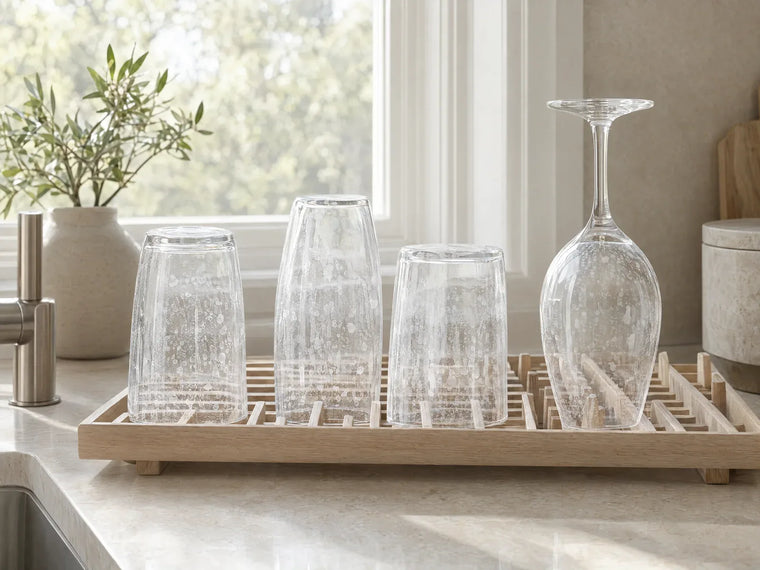
Glasses come out of the dishwasher with spots or a cloudy film, which the USGS calls hard water residue.
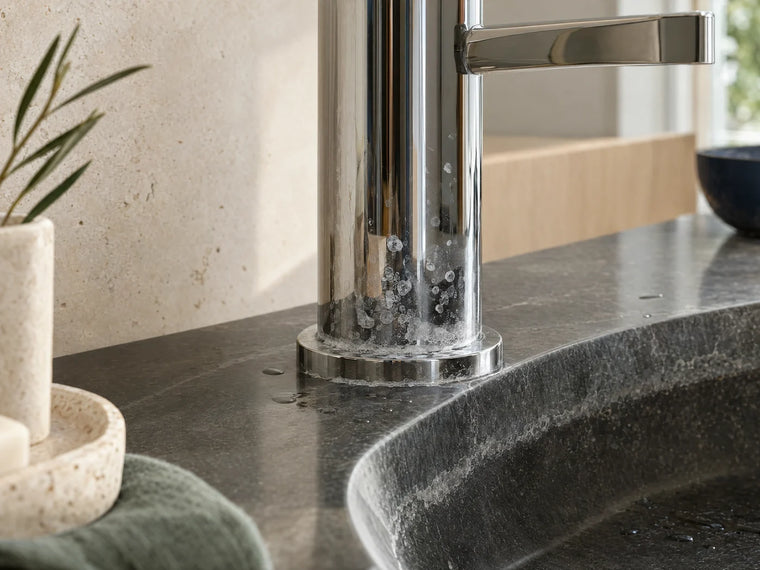
White, chalky scale builds up on faucets, shower trim and other fixtures.

The EPA notes hard water can shorten the life of water heaters, washing machines and other appliances.

You need more soap and detergent to get hands, hair and laundry clean.

Hard water can dry out skin and hair, and soap can leave a film on your hands after washing.

Scale can build up inside pipes and fixtures and slow the flow to showers and faucets.
Hard water is most common in the Southwest and Midwest. These figures come from the local water utility reports behind the map, collected in September 2026. Select a state for its cities.
Average tap water hardness, weighted by the people each utility serves.
The same averages, softest first. Soft water rarely needs a salt-based softener.
The largest US cities with a published utility figure, hardest first.
| City | gpg | mg/L (ppm) | Level |
|---|---|---|---|
| Indianapolis, IN | 18.5 | 317 | Very hard |
| San Antonio, TX | 17.5 | 299 | Very hard |
| Las Vegas, NV | 16.4 | 280 | Very hard |
| Jacksonville, FL | 15.0 | 256 | Very hard |
| Mesa, AZ | 14.7 | 251 | Very hard |
| Phoenix, AZ | 13.9 | 237 | Very hard |
| San Diego, CA | 12.7 | 217 | Very hard |
| Tampa, FL | 12.3 | 211 | Very hard |
| Salt Lake City, UT | 11.6 | 198 | Very hard |
| San Jose, CA | 10.5 | 179 | Hard |
| City | gpg | mg/L (ppm) | Level |
|---|---|---|---|
| Los Angeles, CA | 10.4 | 178 | Hard |
| El Paso, TX | 10.2 | 175 | Hard |
| Omaha, NE | 9.0 | 154 | Hard |
| Albuquerque, NM | 8.8 | 151 | Hard |
| Chicago, IL | 8.2 | 141 | Hard |
| Philadelphia, PA | 8.2 | 140 | Hard |
| Dallas, TX | 8.1 | 138 | Hard |
| Milwaukee, WI | 8.1 | 138 | Hard |
| Houston, TX | 8.0 | 136 | Hard |
| Cincinnati, OH | 7.8 | 133 | Hard |
| Fort Worth, TX | 7.5 | 129 | Hard |
| Fresno, CA | 7.5 | 129 | Hard |
| St. Louis, MO | 7.5 | 129 | Hard |
| Louisville, KY | 7.5 | 128 | Hard |
| Washington, DC | 7.4 | 126 | Hard |
| Cleveland, OH | 6.8 | 117 | Moderately hard |
| Columbus, OH | 6.7 | 115 | Moderately hard |
| Denver, CO | 6.1 | 105 | Moderately hard |
| Detroit, MI | 5.8 | 100 | Moderately hard |
| Kansas City, MO | 5.8 | 100 | Moderately hard |
| Nashville, TN | 5.8 | 100 | Moderately hard |
| Minneapolis, MN | 5.5 | 94 | Moderately hard |
| Austin, TX | 5.4 | 93 | Moderately hard |
| Sacramento, CA | 4.9 | 83 | Moderately hard |
| San Francisco, CA | 3.6 | 62 | Moderately hard |
| Memphis, TN | 2.8 | 48 | Soft |
| Charlotte, NC | 2.2 | 38 | Soft |
| New York, NY | 1.9 | 32 | Soft |
| Seattle, WA | 1.5 | 26 | Soft |
| Raleigh, NC | 1.5 | 25 | Soft |
| Boston, MA | 0.9 | 16 | Soft |
| Portland, OR | 0.5 | 9 | Soft |
The map shows what your water utility reports for your area, usually one figure for the whole system. Your own tap can differ with the source that supplies your street, the season and your plumbing, and a private well can be very different from the town around it.
For an exact number, test your water, especially before you buy a treatment system. City water customers can also find hardness in their utility's yearly Consumer Confidence Report.
Above 120 mg/L (7 gpg), water is generally considered hard and may benefit from softening, and softeners are often recommended above 180 mg/L (10 gpg), according to the EPA.
Below that, many homes are fine as they are. If you still see spots or scale, salt-free scale control is a simple fix.
A water softener removes the hardness minerals. A salt-free conditioner leaves them in the water and reduces the scale they form. Which fits is mostly about what you want.
From $1,531.00
See the systemFrom $2,147.00
See the systemEverything you need to know about water hardness and what it means for your home.
Water hardness is the amount of dissolved calcium and magnesium in your water. Water picks these minerals up as it moves through soil and rock. Hardness is measured in grains per gallon (gpg) or milligrams per liter (mg/L), which is the same as parts per million (ppm). Our complete guide to hard water goes deeper.
Groundwater dissolves calcium and magnesium from limestone, chalk and other mineral deposits as it moves through the ground. Regions with more limestone bedrock tend to have harder water, and areas that rely on groundwater tend to be harder than areas served by rivers and lakes. Read more about what causes hard water and why it varies by location.
Yes. The USGS says hardness is not a health concern, but it can be a nuisance: it leaves mineral buildup in plumbing, fixtures and water heaters, and soaps and detergents work less well. That is why many people choose to treat it.
Start with the map for your area's figure. City water customers can also check their water utility's yearly Consumer Confidence Report. For your exact number, use a home test kit or a lab water test, which is the only way to know a private well's hardness. Our guide on how to test water hardness walks through each method.
Both measure hardness. Grains per gallon (gpg) is the unit water softeners are sized in. Parts per million (ppm) is the same as milligrams per liter (mg/L). To convert ppm to gpg, divide by 17.1: 171 ppm is 10 gpg. Our water hardness converter does the math, including German and French degrees.
The EPA says water above 120 mg/L (7 gpg) is generally considered hard and may benefit from softening, and that softeners are often recommended above 180 mg/L (10 gpg). Below that, many homes are fine as they are, and a salt-free conditioner can reduce scale if you still notice it.
A map shows what your area's water utility reports, usually one figure for the whole system. Your own tap can be softer or harder depending on which source supplies your street, the season and your plumbing. For a private well, nearby wells only give a typical range. Test your water before you buy a treatment system.
Often. Wells draw groundwater, which picks up minerals from rock, while many city utilities treat or blend their water before it reaches you. In a national USGS study of about 2,100 private wells (sampled 1991 to 2004), about 60 percent had hard water. A home test is the only way to know a private well.
Select one more to compare


